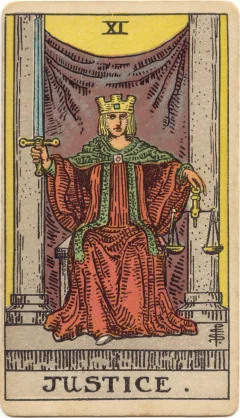
How Justice weighs what someone feels
Justice sits upright with a sword raised in one hand and a pair of scales held perfectly level in the other. The scales are the part to watch in a feelings reading. They suggest emotion that is being weighed: interest, yes, but measured against fairness, timing and what is right for everyone involved.
People who feel things in a Justice way are rarely impulsive. They want the feeling to make sense. That can come across as cool, but it often reflects a deep respect for the other person.
Upright: interest with integrity
Upright, the keywords are fairness and accountability. Behavior tends to be straightforward: clear communication, no games, honest answers to direct questions. Someone with this energy might say "I like you, and I want to be careful because you're also my friend's ex." They may want to settle loose ends, such as ending another situation, before they move toward you.
There is a lot of safety in this card. You are unlikely to be strung along by someone whose feelings run on fairness.
The limit is warmth. A careful mind can overanalyze, and some people need more spontaneity and expressed affection than this style naturally offers.
Reversed: the scales tip
Reversed, the fixed keywords are bias and avoidance. The scales tip. Someone may see the relationship only from their own side, keep a hidden scorecard, or dodge an honest conversation about what went wrong. In quieter forms, it is simply discomfort with accountability: apologizing vaguely, changing the subject, hoping it goes away.
It is worth checking your own scales as well. Are you assuming the worst about someone, or giving yourself a pass you wouldn't give them?
Justice as feelings from an ex
From an ex, Justice often points to feelings tangled up with fairness: who was right, who was hurt, who owes an apology. An ex in this mode might want to talk things through, return belongings, or make sure the split is equitable. Sometimes they feel the ending wasn't fair and keep revisiting it.
The card doesn't tell you whether they want to reconcile. It tends to describe a wish for things to be squared away. If finances or shared property are involved, a qualified professional is the right person to help with that part.
With someone at work
Justice is a fitting card for feelings toward a coworker, because workplaces have their own scales: policies, fairness to the rest of the team, careers on the line. You may notice someone who is clearly interested and equally clearly careful, keeping things professional until they understand what is appropriate.
It can also show up as your own careful weighing. Maybe you like someone on your team and keep asking whether it would be fair to them, to your manager, or to your future self if it went badly. Those questions are not overthinking. They are the right questions, and you can take your time answering them.
That care is a good sign. A colleague who respects boundaries at work is showing you something about how they handle responsibility in general.
Checking the balance
Make two short lists: what you give in this connection, and what you receive. Keep it about effort and respect, not presents. If the lists feel very uneven, that is the conversation to have. Start with one fair, specific request, and notice whether the other person can hear it without defending themselves.